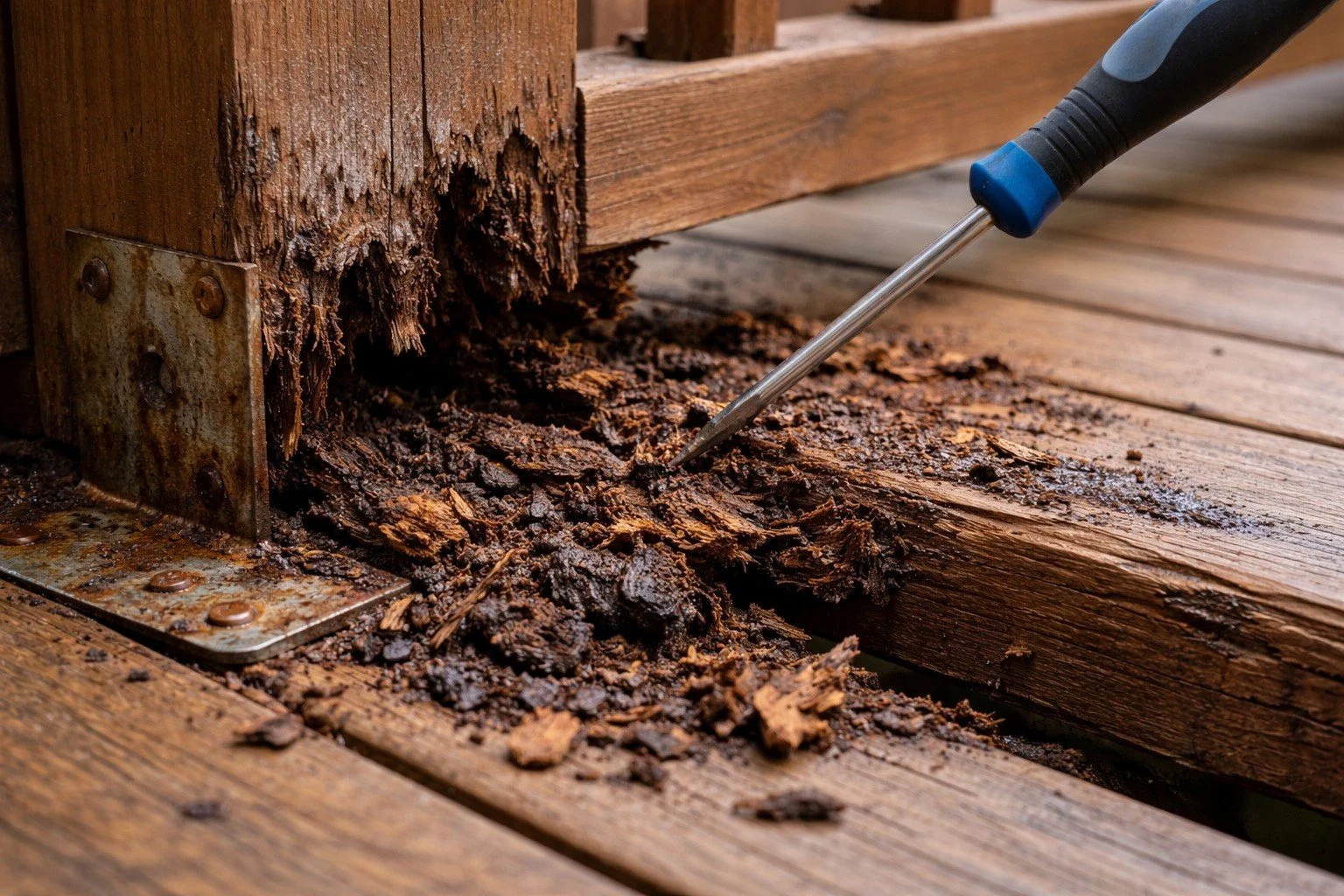
Decayed wood is wood that has lost strength and integrity due to prolonged exposure to moisture and biological activity such as fungi. Over time, this process breaks down the wood fibers, reducing the material’s ability to safely support loads.
Decayed wood is a common issue in exterior building components like decks, balconies, railings, and framing, but it can also occur inside buildings where moisture problems exist.
How Wood Decay Happens
Wood decay occurs when three conditions are present at the same time:
Moisture
Oxygen
Organic wood material
When wood remains damp for extended periods, fungi begin to grow and feed on the wood fibers. As this process continues, the wood weakens and loses its structural capacity. Removing moisture is the most important step in slowing or stopping decay.
Common Causes Of Decayed Wood
Decayed wood usually develops due to ongoing moisture exposure rather than a single event.
Water Intrusion
Leaks from roofs, decks, balconies, or failed waterproofing allow water to reach wood components and remain trapped.
Poor Drainage
Standing water on deck surfaces or around structural connections can lead to long-term saturation.
Failed Flashing or Sealants
When flashing or sealants fail at wall connections, moisture can enter concealed framing and cause hidden decay.
Ground or Soil Contact
Wood components that contact soil or remain close to the ground are more vulnerable to moisture absorption.
Types Of Wood Decay
Surface Decay
Surface decay affects the outer layer of wood and may appear as discoloration or softening. While it can sometimes be cosmetic, it should still be evaluated to confirm it has not spread deeper.
Structural Decay
Structural decay affects load-bearing elements such as joists, beams, posts, or framing inside walls. This type of decay is a serious safety concern and often requires repair or replacement.
Where Decayed Wood Is Commonly Found
Decayed wood is frequently found in:
Decks and balconies
Railing posts and guardrails
Joists and beams
Stair stringers and landings
Siding near leaks
Window and door framing
Exterior elevated structures are especially vulnerable because they are exposed to weather and moisture year-round.
Why Decayed Wood Is A Safety Concern
As wood decays, it gradually loses strength and stiffness, which can compromise the safety of the structure. This deterioration can lead to sagging or movement in decks and balconies, loose or unstable railings, cracking or separation at connections, and an increased risk of collapse or failure.
In many cases, decayed wood is hidden beneath finished surfaces, making the problem difficult to detect without a proper inspection.
How Inspectors Identify Decayed Wood
Inspectors use a combination of visual and physical evaluation methods to identify decay.
Visual Indicators
Discoloration, staining, fungal growth, or cracking may indicate moisture damage.
Physical Testing
Softness, crumbling, or loss of resistance when probed can signal decay.
Moisture Assessment
Moisture conditions are evaluated to determine whether decay is active or likely to worsen. In some cases, concealed areas may require more detailed evaluation to confirm the extent of damage.
Experienced inspection providers such as Great Escape Service & Inspection evaluate both visible and concealed wood components to determine the extent of decay and related safety risks.
Decayed Wood and Exterior Inspections in California
In California, decayed wood is a common finding during inspections of exterior elevated elements such as decks, balconies, walkways, and stairs.
When these elements are part of regulated buildings:
Decayed wood may be cited as a safety concern
Repairs may be required within defined timelines
Structural decay can trigger further evaluation or permit
For apartments, inspections may occur under CA-SB 721, and for condominiums or HOAs, inspections may occur under CA-SB 326, depending on the building type and conditions.
Can Decayed Wood Be Repaired?
Yes, some decayed wood can be repaired, while other situations require replacement. The correct approach depends on:
The severity of the decay
Whether the wood is load-bearing
The location of the affected component
Applicable safety and permit requirements
Cosmetic or limited surface decay may be repairable, but structural decay usually requires professional evaluation and corrective work.
When Decayed Wood Should Not Be Ignored
Professional inspection is strongly recommended when:
Wood feels soft, spongy, or crumbles
There is visible movement or sagging
Multiple areas show signs of moisture damage
The affected wood supports an elevated structure
The building is part of a multi-family or HOA-managed property
Ignoring decayed wood can allow damage to spread and increase repair costs and safety risks.
How Great Escape Service & Inspection Can Help With Decayed Wood
When decayed wood is identified, Great Escape Service & Inspection helps homeowners, property managers, and HOAs understand the severity of the issue and the correct next steps.
Our inspections focus on determining whether the decay is cosmetic or structural, identifying moisture sources, and assessing how the affected wood impacts overall safety. Based on inspection findings,
We provide clear documentation and guidance to support timely repairs, compliance requirements, and long-term protection of decks, balconies, and other exterior wood components.
Conclusion
Decayed wood is the result of prolonged moisture exposure and biological activity that weakens wood over time. While some decay may begin at the surface, deeper structural decay can develop unnoticed and create serious safety concerns.
Understanding what decayed wood is, where it commonly occurs, and how it is identified during inspections helps homeowners and property managers take timely action. When decay affects load-bearing or exterior elevated elements, professional inspection and proper repairs are essential to maintaining safety and compliance.
People Also Ask:
What is decayed wood?
Decayed wood is wood that has weakened due to long-term moisture exposure and fungal activity. It loses strength and may no longer safely support loads.
What causes wood to decay?
Wood decays when it stays damp for extended periods and is exposed to oxygen. Leaks, poor drainage, and failed waterproofing are common causes.
Is decayed wood dangerous?
Yes. Decayed wood can compromise structural stability and increase the risk of failure, especially in decks and balconies.
How can you tell if wood is decayed?
Signs include softness, crumbling, discoloration, and movement. Some decay may be hidden and require inspection to confirm.
Can decayed wood be repaired?
Some minor decay can be repaired, but structural decay often requires replacement. A professional evaluation is recommended.
Does surface decay always mean structural damage?
Not always, but surface decay can indicate deeper moisture problems. It should be assessed to confirm the extent.
Where is decayed wood most commonly found?
It is commonly found in decks, balconies, railings, joists, stairs, and areas near leaks.
Is decayed wood common in exterior structures?
Yes. Exterior structures are more exposed to moisture and weather, making decay more likely.
Is decayed wood checked during inspections?
Yes. Inspectors routinely check for signs of decay, especially in exterior elevated elements.
Who should inspect decayed wood issues?
Qualified inspection professionals should evaluate decayed wood to determine severity and required repairs.